

Case study:
One of the achievements of MHMET is providing/offering consultation to our partners, an example of which was the repair of the Heat Exchanger with shell made of SA 387 Gr 11 CL1 and 102 mm thickness; it was in such a condition with lots of cracks from tube sheet to the shell weld line. It was a circumferential weld line, half of which was filled by cracks.
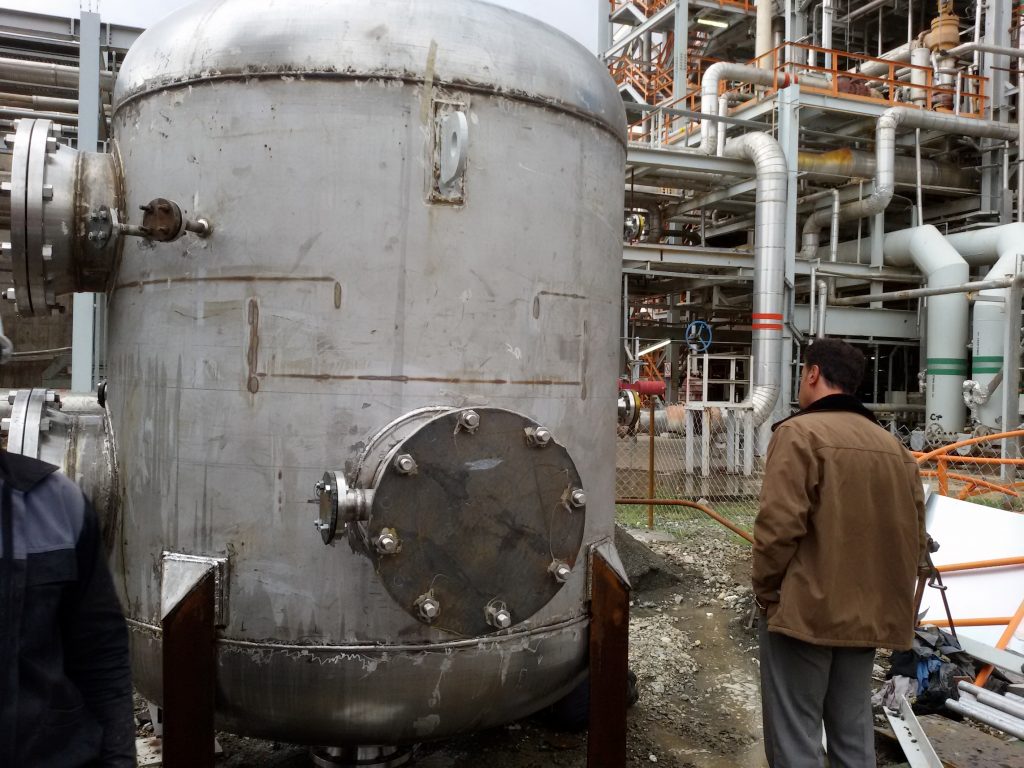
This exchanger was located in special operation condition and for any maintenance activities it must be isolated; otherwise, N2 purging must be flooded in operation loop. Besides, isolating the exchanger was somewhat impossible, and for this purpose and according to this fact that N2 was purging inside the shell side, the cracks should be removed from the detected area (all the cracks initiated from the inside of the shell).
After checking all the conditions and conducting a UT test, NDT, TOFD and Phase array. it was found that inside the shell, there were a lot of cracks. Crack propagation was detected into the base metal. Considering the fact that there was no access to the inside of the shell, two questions arose: The Tubes were inside the shell and could be damaged, however; Was it possible to grind the base metal? How much was the allowable length of weld if the crack propagation was detected into the base metal? After resolving these issues, it was decided that the base metal must be ground through Arc Gouging for 97 mm and at the end grinding for 5 mm.
SMAW and GTAW Welding processes were performed, and then, some types of heat treatments such as DHT (Dehydrogenation Heat Treatment) and PWHT were applied and finally a UT test was administered to check soundness of the part.
Specialists in MHMET analyzed all the possible destruction mechanisms including Thermal fatigue, SOHIC, HTHA, HIC, Ammonia Grooving, Ammonia SCC and DMW according to the type of fluid, temperature and pressure. It was finally concluded that HIC (HIC is the cracking that occurs as a result of the penetration of hydrogen into the metals and causing stress and blisters in them which led to formation of cracks in susceptible areas) was the cause of the defects. Therefore, it is strongly suggested that a UT test be performed every year to prevent such defects and to confirm the soundness of converter.